Week 08: Elementary Graphs (Lab)

Bingjie Xu

2026-02-26

Intro

Learning Objectives

  1. Implement graph traversal algorithms (BFS, DFS) in C++.

  2. Determine reachability between nodes in a graph.

  3. Perform topological sorting on directed acyclic graphs (DAGs).

  4. Identify connected components using BFS/DFS in C++.

Overview of Lab Activities

This lab consists of three main activities:

  1. Reachability in an Unweighted Graph (20 marks)
    • Implement a function to determine if a path exists between two vertices in a directed graph using BFS or DFS.
    • Submit your C++ implementation via Gradescope.
  2. Topological Sorting of a DAG (10 marks)
    • Model the process of getting dressed in the morning as a directed acyclic graph (DAG).
    • Draw the DAG and compute a valid topological ordering using DFS.
    • Submit your DFS and topological order via xSITe Dropbox.
  3. Connected Components (30 marks)
    • Implement an algorithm to identify all connected components in an undirected graph using BFS or DFS.
    • Submit your C++ implementation via Gradescope.

Reachability in an Unweighted Graph

Application

A real-world application of reachability queries is determining if you can travel from one station to another in a transportation network. For example, in the Singapore (MRT) system, you might want to know if there’s a path from Dhoby Ghaut to Bencoolen.
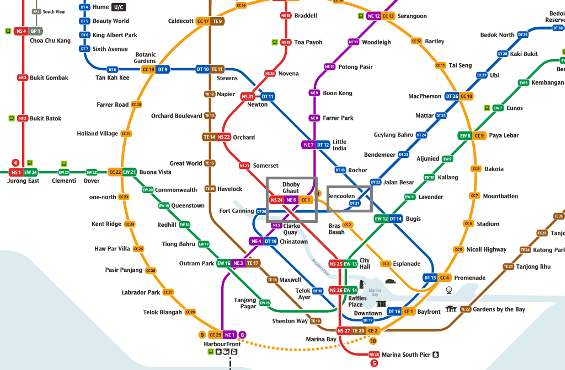
In this graph representation: Vertices represent MRT stations. Edges represent train lines connecting stations. A reachability query answers: “Can I get from station \(s\) to station \(t\)”?

Exercise

You are given an unweighted undirected graph \(G = (V, E)\) in form of edges. Your task is to decide whether there is a path from a source vertex \(s\) to a target vertex \(t\).
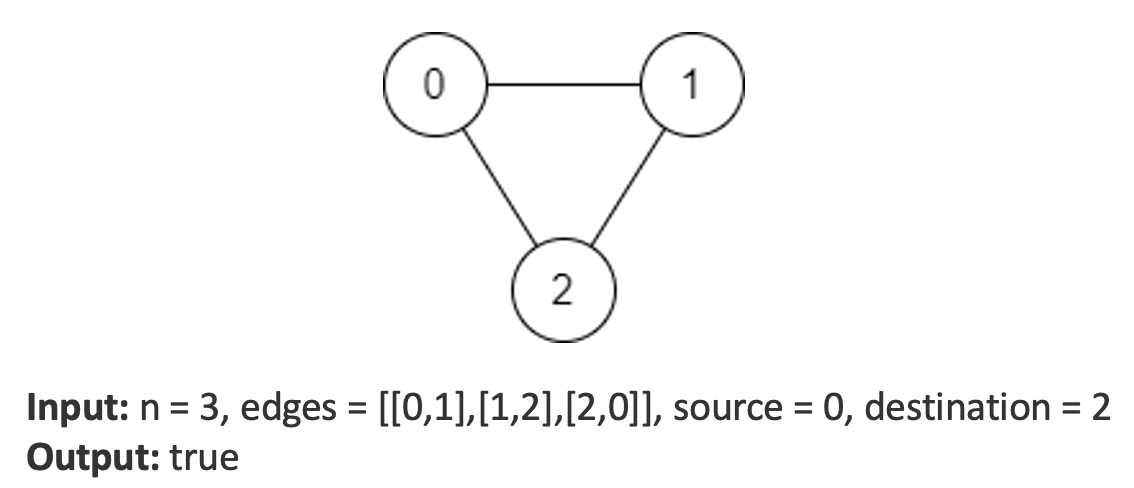
  1. Download valid_path.zip from xSITe. valid_path.cpp contains a stub for function bool validPath(int n, vector<vector<int>> &edges, int source, int destination);
  2. Build an adjacency list representation of the graph from the edge list.
  3. Implement reachable using BFS or DFS so that it runs in \(O(|V| + |E|)\).
  4. Make and Test your implementation locally using the provided test.txt.

Submission (Gradescope, 20 marks). Upload your completed valid_path.cpp on Gradescope.

Constraints

  • The number of vertices \(|V|\) is between 1 and 2 * \(10^5\) (inclusive).
  • The number of edges \(|E|\) is between 0 and 2 * \(10^5\) (inclusive).
  • Vertices are labeled from 0 to \(|V| - 1\).
  • There are no duplicate edges.

Activity 1: Key points

  • Build an adjacency list representation of the graph from the edge list.
  • Use BFS (with a queue) or DFS (with a stack or recursion) to explore all reachable vertices from the source.
  • Mark vertices as visited to avoid revisiting them.
  • Return true immediately when the destination is found.
  • Return false if all reachable vertices have been explored (queue/stack is exhausted or recursion completes) without finding the destination.

Topological Sort

Use Cases of Topological Sort

Topological sorting is useful in many real-world applications:

  • Task Scheduling: Determining the order of tasks with dependencies (e.g., building software, course prerequisites)
  • Event Ordering: Finding a valid sequence of events that respects precedence constraints
  • Dependency Resolution: Resolving dependencies in package managers (e.g., npm, pip)
  • Course Prerequisites: Determining a valid course enrollment sequence
  • Build Systems: Compiling source files in the correct order based on dependencies

Directed Acyclic Graph (DAG)

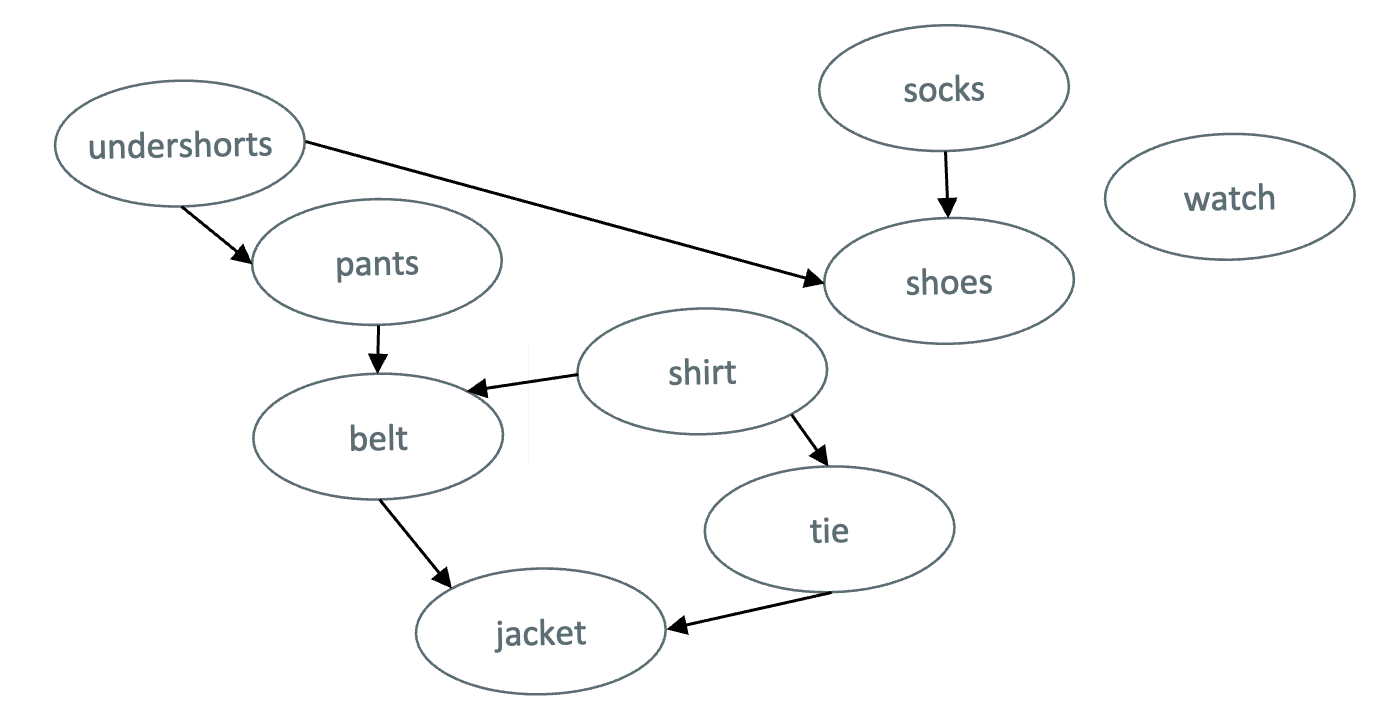
A Directed Acyclic Graph (DAG) is a directed graph with no cycles. This property is essential for topological sorting - if a graph contains cycles, no valid topological ordering exists.

Example of a Directed Acyclic Graph (DAG):
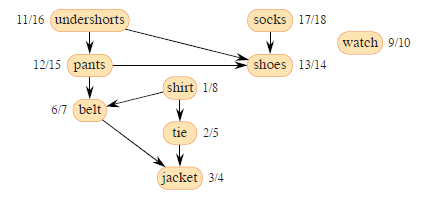
One of many valid DFS trees on the DAG, assuming shirt is the source vertex:
Topological Sort

Topological sort (or topological ordering) is a linear ordering of the vertices of a directed acyclic graph (DAG) such that for every directed edge \((u, v)\), vertex \(u\) comes before vertex \(v\) in the ordering.

Topological sort can be performed using DFS. The key insight is to process nodes in reverse order of finishing times during DFS.

The resulted topological sorting:

The valid topological order might not be unique because DFS can produce different orderings depending on the starting node and the order of neighbor selection. However, any topological order produced will always remain valid (a node will appear before its dependent nodes).

Topological Sort Pseudo Code

TOPOLOGICAL-SORT(G):
    1. Initialize an empty list L for the topological order
    2. For each vertex v in G:
        3. If v is not visited:
            4. DFS-VISIT(G, v, L)
    5. Return L (reversed)

DFS-VISIT(G, v, L):
    1. Mark v as visited
    2. For each neighbor u of v:
        3. If u is not visited:
            4. DFS-VISIT(G, u, L)
    5. Add v to the front of L (or push to stack)

Exercise: Getting Dressed DAG

Model “getting dressed in the morning” as a DAG.
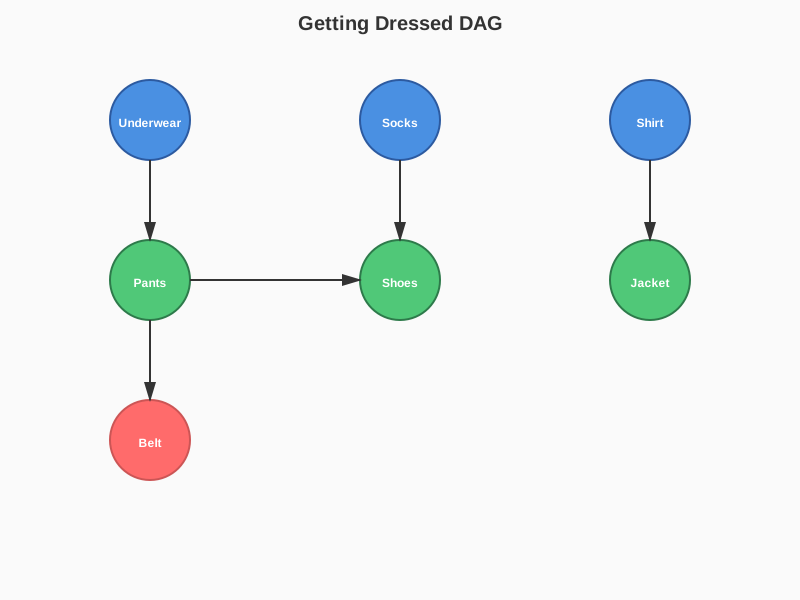
  1. Choose source vertex Underwear.
  2. Use DFS‑based traversal approach.
  3. Compute a valid topological sorting.

Submission (xSITe Dropbox, 10 marks). Upload your DFS spanning tree with visiting and finishing times, and the corresponding topological order.

Activity 2: Key points

  • In a valid topological order all edges go from left to right.
  • If your algorithm detects a cycle, your graph is not a DAG and must be fixed.
  • DFS-based topological sort processes nodes in reverse finishing time order.

Connected Components in an Undirected Graph

Connected Components

A connected component of an undirected graph is a maximal set of vertices such that there is a path between every pair of vertices in the set. In other words, all vertices in a connected component are reachable from each other.
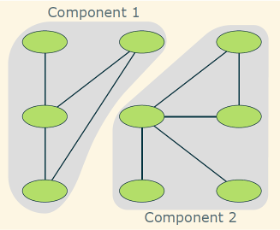
Connected Components Example: The graph above has 2 connected components.

Use Cases of Connected Components

Connected components have numerous real-world applications:

  • Network Analysis: Identifying isolated subnetworks or clusters in computer networks, social networks, or communication systems
  • Image Processing: Finding connected regions in binary images (e.g., identifying objects, characters in OCR)
  • Geographic Information Systems (GIS): Finding connected landmasses, road networks, or water bodies
  • Puzzle Solving: Determining if all pieces of a puzzle are connected or if there are separate groups
  • Game Development: Detecting if game objects or regions are connected (e.g., pathfinding, territory control)

Exercise

You are given an undirected graph with \(n\) vertices and a list of edges. Your task is to count the number of connected components in the graph.

  1. Download connected_components.zip from xSITe. The file connected_component.cpp contains a stub for function int countComponents(int n, vector<vector<int>> &edges);
  2. Implement countComponents to return the number of connected components in the graph.
  3. Use BFS or DFS to explore each connected component.
  4. Make and Test your implementation locally using the provided test.txt.

Submission (Gradescope, 30 marks). Upload your completed connected_component.cpp file on Gradescope.

Activity 3: Key points

  • Build adjacency-list representation of graph from the edge list.
  • Maintain a visited array and current_component_id.
  • For each unvisited vertex, start BFS/DFS, label all reachable vertices, then increment current_component_id.

Strongly Connected Components (SCC)

For directed graphs, we use the concept of Strongly Connected Components (SCC). A strongly connected component is a maximal set of vertices such that for every pair of vertices \(u\) and \(v\) in the set, there is a directed path from \(u\) to \(v\) and from \(v\) to \(u\).
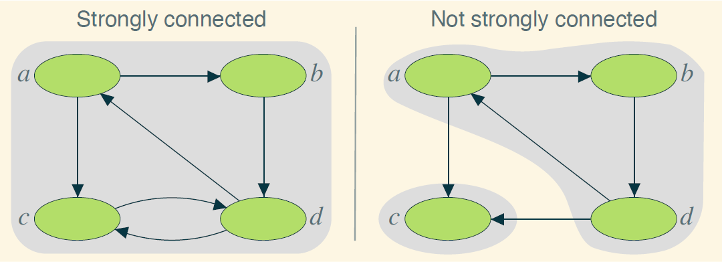
Strongly Connected Component Example: A single SCC in a directed graph.
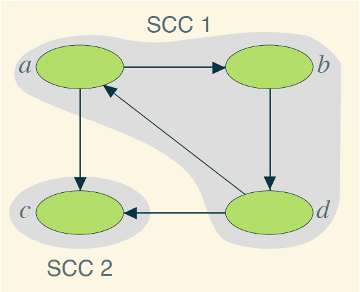
Multiple SCCs Example: A directed graph with multiple strongly connected components.

Conclusion

Wrap-up

By the end of this lab you should be able to:

  1. Implement reachability queries in directed graphs.
  2. Model constraints as DAGs and compute a topological order.
  3. Compute connected components in undirected graphs using BFS/DFS.

Outlook

Elementary Graph Algorithms
Representations, breadth-first and depth-first search, topological sorting, connected components
Disjoint Sets and Minimum Spanning Trees
Union-find data structures, Kruskal’s and Prim’s minimum-spanning-tree algorithms
Single-Source Shortest Paths
Dijkstra’s and Bellman-Ford algorithms
Dynamic Programming and Greedy Algorithms
Versatile optimization techniques